
TMJ Dysfunction, Upper Cervical Misalignment, and the Connection Most People Miss
- Jun 25
- 4 min read

Jaw pain can affect far more than your ability to chew comfortably. For some people, it begins with clicking or popping in the jaw. For others, it becomes chronic facial tension, headaches, ear pressure, dizziness, or neck pain that slowly worsens over time. Eating becomes uncomfortable. Sleep becomes disrupted. Even daily conversations can aggravate symptoms.
Temporomandibular joint disorders, commonly referred to as TMJ or TMD, affect millions of Americans and remain one of the leading causes of facial pain. Yet despite how common these conditions are, many people spend years chasing symptoms without ever addressing the underlying structural cause.
At Atlas Specific in Durango, Dr. Danielle takes a different approach. Rather than focusing only on the jaw itself, she evaluates how the upper cervical spine, nervous system, posture, and craniofacial muscles work together as a connected system.
Understanding the TMJ
The temporomandibular joints sit just below each ear and connect the lower jaw to the skull. These joints are responsible for the movements required for chewing, speaking, swallowing, yawning, and facial expression.
When the TMJ becomes irritated or dysfunctional, symptoms can extend well beyond the jaw itself. Common TMJ symptoms include:
Jaw pain or tenderness
Clicking or popping sounds
Jaw locking or limited movement
Headaches or migraines
Ear pain or ringing in the ears (tinnitus)
Facial tension or muscle spasms
Neck and shoulder tightness
Dizziness or balance changes
Changes in bite alignment
For some patients, symptoms remain mild and intermittent. For others, TMJ dysfunction becomes chronic, frustrating, and deeply disruptive to daily life.
Why TMJ Dysfunction Often Involves the Neck
One of the most overlooked aspects of TMJ dysfunction is the close relationship between the jaw and the upper cervical spine. Dr. Danielle frequently works with patients who have spent years focusing solely on the jaw itself, only to discover that the real issue may involve an imbalance in the upper neck.
At the top of the cervical spine are the atlas (C1) and axis (C2), two vertebrae that help support the head and protect the brainstem. This region also sits in close relationship to the trigeminal nerve, one of the major nerves involved in jaw movement and facial sensation. When the upper cervical spine loses proper alignment, the body often begins compensating in subtle ways:
Head posture shifts forward
Muscles tighten unevenly
The jaw may track improperly
Stress increases throughout the surrounding musculature
Over time, this compensation can place ongoing strain on the temporomandibular joints and contribute to chronic inflammation, muscle tension, and dysfunction. This is why TMJ symptoms are so often accompanied by headaches, neck stiffness, facial pain, shoulder tension, and dizziness. The jaw and neck are not functioning independently. They are part of the same structural and neurological system.
Dr. Danielle’s Approach to TMJ Care
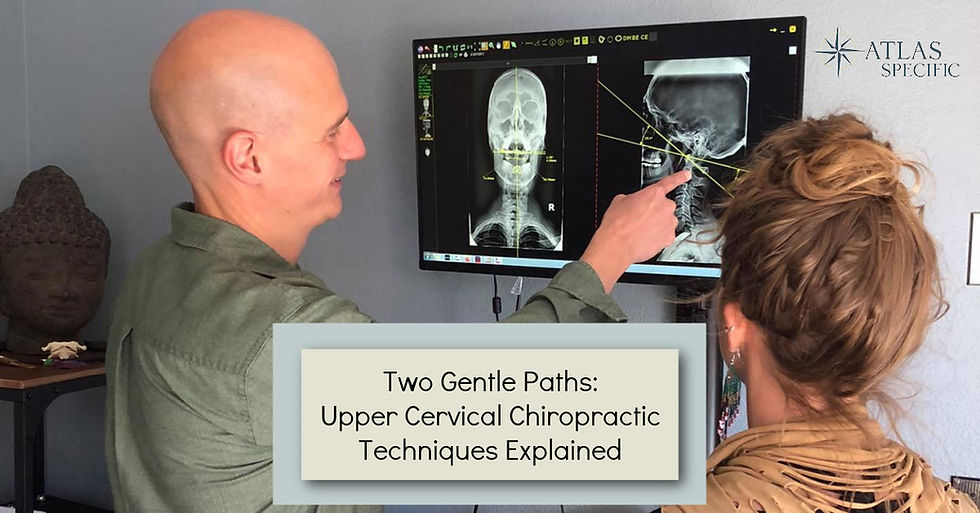
Dr. Danielle focuses on identifying whether upper cervical misalignment may be contributing to jaw dysfunction and facial pain. Using detailed imaging and precise upper cervical analysis, she evaluates how the head and neck are functioning structurally and how those mechanics may be influencing the jaw, muscles, and nervous system.
Upper cervical care is very different from generalized neck manipulation. Corrections are gentle, highly specific, and designed to restore balance without forceful twisting or aggressive movements. The goal is to reduce interference within the nervous system and help the body function with less compensation and strain.
Rather than simply chasing symptoms, Dr. Danielle works to address the structural imbalance that may be contributing to the problem in the first place. Many patients under care report improvements such as:
Reduced jaw tension
Fewer headaches and migraines
Less facial pressure
Improved neck mobility
Better posture and balance
Decreased muscle guarding and tightness
Every patient responds differently, and no single treatment is right for everyone. But for many people struggling with chronic TMJ symptoms, evaluating the upper cervical spine can provide an important missing piece.
Looking Beyond the Jaw
TMJ disorders can be complex because the symptoms often seem disconnected. Jaw pain, headaches, dizziness, neck tension, and ear pressure may not immediately appear related, yet they frequently stem from the same underlying mechanical imbalance.
Dr. Danielle’s approach is centered on helping patients understand those connections and supporting the body’s ability to function more naturally and efficiently. If you’ve been struggling with TMJ symptoms and are looking for a gentle, conservative approach, Atlas Specific is here to help.
We proudly serve patients throughout Durango, Bayfield, Ignacio, Mancos, Cortez, Pagosa Springs, Farmington, Aztec, and surrounding communities. To schedule a free consultation with Dr. Danielle, click the link below, call 970-259-6803, or visit our Durango office.

Notice of Disclaimer:
We are doctors of upper cervical chiropractic, but we are NOT necessarily YOUR doctors. All content and information on this website are for informational and educational purposes only, do not constitute medical advice, and reading or interacting with this site does not establish any form of the patient-doctor relationship. Although we strive to provide accurate information, the information presented here is not intended as a substitute for any kind of professional advice, and you should not rely solely on this information. Always consult a professional in your particular area of need before making medical decisions.


Comments